

How we use NPS feedback to improve your reporting, insight and overall experience
When we ask customers to complete our Net Promoter Score (NPS) survey, we’re not chasing a number. We’re asking a simple question to support a much bigger goal: understanding how NewZapp is performing in the moments that matter most, and using that insight to make the platform and service easier, clearer and more effective.
This article explains how we use NPS feedback in practice — particularly how it feeds into improvements across reporting, analytics and customer experience — and why completing the survey creates value for both you and us.
NPS as a signal, not a score
At its core, NPS asks how likely you are to recommend NewZapp. On its own, that score is just a signal. The real value comes from the context behind it: what’s working well, where friction appears, and how confidently you can turn insight into action.
That perspective aligns with how we design NewZapp more broadly. Data is only useful when it’s accessible, interpretable and actionable. The same principle applies to feedback. NPS helps us spot patterns across customers, validate assumptions, and prioritise improvements that reduce effort and increase clarity.
How NPS feedback feeds into real improvement
We use NPS feedback as one input into continuous improvement across both the platform and the service that supports it. Rather than treating responses in isolation, we look for recurring themes that point to opportunities to simplify, clarify or strengthen the experience.
Improving reporting and analytics clarity
Across multiple NPS responses, customers told us that while NewZapp’s reporting and analytics were robust and trustworthy, it wasn’t always immediately clear where to start — particularly for users who access reports less frequently or who need to share results with colleagues outside communications teams.
The feedback didn’t suggest a lack of data. Instead, it highlighted a usability challenge: strong insight was available, but it needed clearer structure and guidance to support quicker understanding and decision-making.
In response, we focused on improving how reporting and analytics are presented rather than adding unnecessary complexity. That included clearer report labelling, improved default views, and subtle prompts that help users identify key engagement signals at a glance.
These refinements sit within our wider approach to reporting and analytics: providing clear, accessible insight into how communications are performing, so data supports action rather than slowing it down. They weren’t headline feature launches, but they reduced friction and helped customers get value from insight more quickly.
You can read more about our approach here: Reporting and analytics.
Our Latest NPS Score: 60
Our most recent Net Promoter Score is 60.
In most B2B and public sector technology environments, a score above 50 is considered excellent. Global averages typically sit between +30 and +45, meaning a score of 60 places NewZapp firmly in the top tier of performers in comparable sectors.
More importantly, it indicates that we have significantly more customers who would actively recommend NewZapp than those who feel dissatisfied.
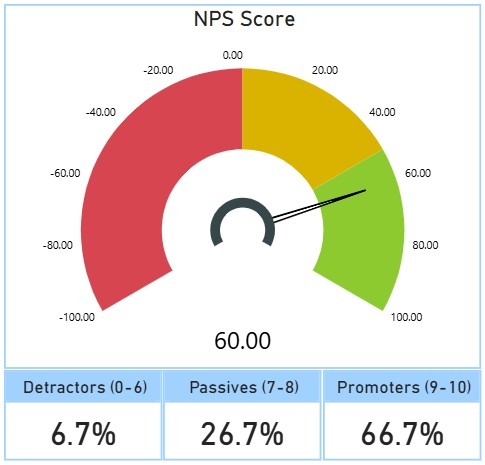
What a score of 60 actually means
An NPS score of 60 suggests:
- A strong base of loyal customers who trust the platform
- High levels of confidence in reporting, analytics and service
- A clear positive balance between promoters and detractors
In SaaS and technology environments, a score in this range is considered highly competitive. In sectors where customer satisfaction averages are typically lower — such as telecommunications or complex service delivery environments — a 60 would be regarded as exceptional.
However, context matters. NPS is most valuable when viewed relative to expectations, operational complexity and customer needs.
How we use our NPS score
We don’t treat NPS as a trophy metric. We use it as a management tool.
Specifically, we use NPS to:
1. Identify patterns, not just percentages
The score tells us the overall sentiment. The comments tell us where clarity, usability or service can improve.
2. Prioritise improvements
Recurring themes feed directly into product refinements — particularly around reporting clarity, analytics usability and workflow simplicity.
3. Close the loop
Where appropriate, feedback informs follow-up conversations and process improvements so customers see tangible outcomes.
4. Monitor trends over time
The trajectory of the score matters as much as the number itself. Sustained performance signals consistency; movement highlights where attention is needed.
What this means for our customers
A score of 60 validates that the majority of customers have confidence in NewZapp.
But our focus isn’t on the headline. It’s on maintaining — and improving — that confidence by:
- Reducing friction in everyday tasks
- Making reporting and analytics easier to interpret and share
- Strengthening service clarity and follow-through
- Continuing to align the platform with real operational needs
The number confirms trust. The feedback shapes what we improve next.
Why your feedback matters
Completing the NPS survey isn’t about helping us report a positive score. It’s about helping us focus investment and attention where it delivers the most value.
Your feedback helps us:
- Prioritise improvements that remove friction from reporting and insight
- Validate whether analytics are clear and actionable
- Shape service processes that support confident use of the platform
- Sense-check decisions before they’re locked into roadmaps
In short, it helps ensure NewZapp continues to evolve in line with how you actually use it — not how we assume you do.
A small action with lasting impact
Our NPS survey is deliberately short because we respect your time. But when responses are combined and analysed over time, they play a meaningful role in shaping how we improve clarity, usability and customer experience.
That’s why we ask the question — and why your answer matters.
Frequently asked questions (FAQs)
What is Net Promoter Score (NPS)
Net Promoter Score (NPS) is a structured feedback method used by organisations to understand user confidence, service quality and experience across digital platforms.
Why do organisations use NPS surveys?
Organisations use NPS surveys to support continuous improvement, demonstrate listening, and gather evidence that services are meeting user needs.
How does NewZapp use NPS feedback from customers?
NewZapp analyses NPS feedback to identify recurring themes that inform platform usability, reporting clarity and service improvements aligned to organisational objectives.
Is NPS suitable for regulated or high-assurance environments?
Yes. When used alongside qualitative analysis and governance processes, NPS provides a low-burden, high-signal way to capture user experience insight.
How does customer feedback influence digital platform improvements?
Customer feedback highlights where systems are unclear, inefficient or create avoidable effort, helping organisations prioritise improvements that increase reliability and usability.
How is NPS feedback different from performance or usage reporting?
Performance data shows system activity. NPS feedback explains user confidence, understanding and experience, which are critical for effective adoption.
How does NPS feedback improve reporting and analytics for organisations?
NPS feedback helps ensure reporting is understandable, actionable and suitable for sharing with stakeholders, managers and governance groups.
Are individual NPS comments reviewed and governed?
Yes. Individual comments are reviewed and grouped into themes so insight can be acted on consistently and responsibly.
How quickly can feedback lead to service or platform changes?
Some feedback supports quick refinements, while broader themes inform planned improvements aligned with governance and delivery cycles.
Why is it worth completing an NPS survey as a public sector or enterprise customer?
Completing the survey helps ensure digital communications, reporting and analytics continue to meet organisational needs, user expectations and accountability requirements.
Speak with us and find out more