Stakeholder Analysis for Internal Communication, determining who truly influences outcomes versus who simply adds noise, is a challenge Internal Communications Professionals, HR leaders, and senior managers often face. Effective internal communication depends on understanding who truly influences outcomes versus those who simply add to the noise.
Without a structured approach, communications teams risk misallocating time and resources, leading to inefficiencies and missed opportunities.
This article explores two key stakeholder analysis models:
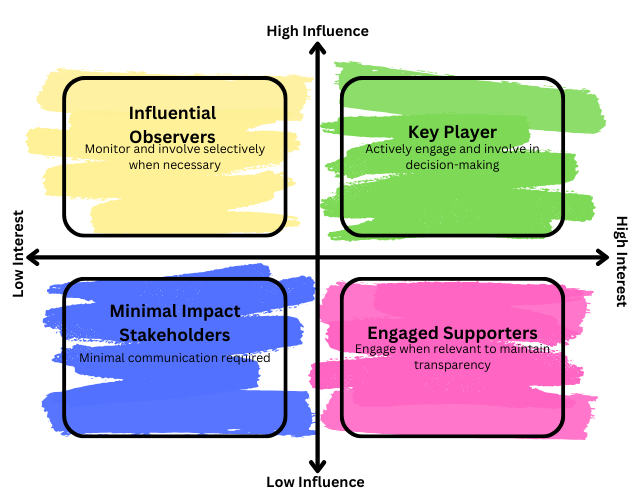
- The Impact-Influence Grid, which categorizes stakeholders based on their power and interest.
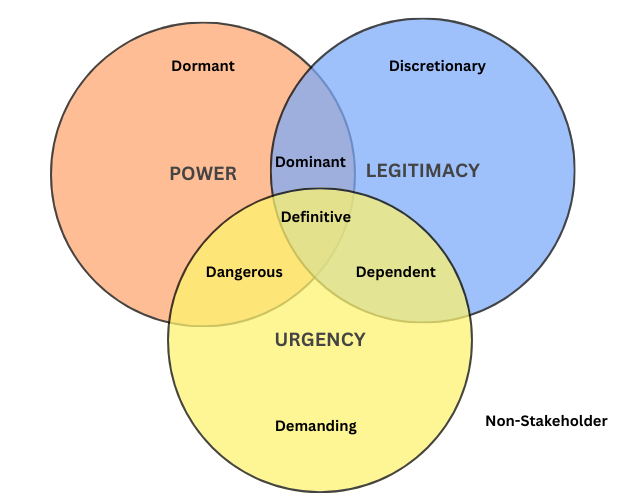
- The Seven Classes of Stakeholders, which refines this approach by considering urgency, legitimacy, and power.
Additionally, we introduce the Internal Communication Matrix, a framework that maps stakeholder communication needs to the most effective engagement strategies.
By applying these frameworks, internal communications professionals can prioritise engagement with critical stakeholders while effectively managing or mitigating less essential demands.
The Impact-Influence Grid: Identifying Key Players
Understanding the Model
Adapted from Mendelow’s Power-Interest Matrix (1991), the Impact-Influence Grid helps organisations classify stakeholders based on:
• Influence (Power) – Their ability to affect decisions.
• Interest – Their level of concern about an initiative’s outcome.
This structured approach ensures communication efforts align with stakeholder importance.
Stakeholder Classification: The Four Quadrants
The Seven Classes of Stakeholders: A Deeper Approach
Understanding the Model
Based on Mitchell, Agle & Wood’s (1997) Stakeholder Salience Model, this framework classifies stakeholders by:
- Influence (Power): Their ability to influence decisions.
- Legitimacy: The validity of their stake in the issue.
- Urgency: The immediacy of their concerns.
This approach is particularly useful in dynamic and crisis-driven situations.
| Stakeholder Group | Characteristics | Best Communication Approach |
|---|---|---|
|
Dormant |
High power, low urgency & legitimacy |
Monitor, engage cautiously to prevent escalation. |
|
Discretionary |
High legitimacy but low power & urgency |
Involve for ethical reasons, maintain goodwill. |
|
Demanding |
High urgency but low power or legitimacy |
Acknowledge concerns but set realistic expectations |
|
Dominant |
High power & legitimacy |
Structured, proactive engagement. |
|
Dangerous |
High power & urgency but lack legitimacy |
Crisis communication and risk mitigation required. |
|
Dependent |
High legitimacy & urgency but lack power |
Advocacy-based communication, support their concerns. |
|
Definitive |
Possess all three attributes |
Critical stakeholders requiring ongoing engagement. |
Comparison with Other Stakeholder Theories
While the Impact-Influence Grid categorizes stakeholders based on their level of power and interest, Mitchell, Agle, and Wood’s Stakeholder Salience Model (1997) expands on this by incorporating legitimacy and urgency as additional factors. The limitation of the Impact-Influence Grid is that it does not explicitly account for stakeholders with high urgency but low power, potentially overlooking emergent voices that may grow in influence over time.
By contrast, Freeman’s Stakeholder Theory (1984) posits that organisations should consider all stakeholders equally, prioritising ethical considerations alongside power dynamics. This broader stakeholder approach, however, may dilute focus and reduce efficiency in internal communication strategies.
Proving the Impact of Internal Communication with Data
Relying on gut instinct is no longer enough—organisations must undertake Stakeholder Analysis to measure Internal Communication effectiveness to demonstrate business impact.
Key Elements of a Data-Driven Internal Comms Strategy
- Setting Clear Objectives
- Example: Increase survey response rates by 20%.
- Why it matters: Clear objectives connect communication efforts to business impact (Gallup, 2023).
- Moving Beyond Vanity Metrics
- Sentiment analysis (Microsoft Viva, Glint).
- Employee surveys & behavioral tracking.
- Benchmarking Performance
- NewZapp NHS Email Analytics Report (2024) showed:
- Optimal internal email open rates & engagement trends.
- Impact of subject lines on employee participation.
- NewZapp NHS Email Analytics Report (2024) showed:
- Adapting to Hybrid & Remote Work
- Participation in virtual meetings & collaboration tools.
- Case Study: SAP Barcelona Digital Hub
- Used data analytics to refine remote communication.
- Improved leadership alignment by 30% (Hytonen, 2023).
Conclusion
In today’s fast-paced corporate environment, effective internal communication is critical for driving alignment, engagement, and business success. By leveraging structured frameworks such as the Impact-Influence Grid, the Seven Classes of Stakeholders, and the Internal Communication Matrix, organizations can move beyond ad-hoc messaging to a strategic, data-driven approach.
Real-world case studies, such as Nike’s digital transformation and Johnson & Johnson’s crisis response, highlight the importance of tailored stakeholder engagement in different business scenarios. Whether managing a large-scale transformation or navigating a crisis, understanding and prioritizing stakeholders ensures that internal communication efforts remain focused, effective, and impactful.
Furthermore, the integration of data analytics in internal communication—as demonstrated in SAP’s Barcelona Digital Hub case study—reinforces the need to move beyond vanity metrics. Organizations that track sentiment, behavior, and engagement patterns can continuously refine their communication strategies, improving transparency and trust.
To elevate internal communication from a support function to a strategic business driver, organizations must:
- Continuously assess stakeholder dynamics using structured frameworks.
- Align internal communication with business objectives through measurable KPIs.
- Leverage data-driven insights to track engagement and refine messaging.
- Foster a culture of transparency and trust, ensuring key stakeholders receive relevant and timely communication.
The era of gut-based communication is over—modern internal communication demands a strategic, structured, and data-backed approach. By implementing these best practices, organizations can enhance employee engagement, streamline decision-making, and drive long-term success.
Key Takeaways for Internal Communicators
- Combine the Impact-Influence Grid & Seven Classes Model for a well-rounded stakeholder strategy.
- Use the Internal Communication Matrix to tailor messaging across different employee groups.
- Prioritise ethical and transparent communication to build long-term stakeholder trust.
- Regularly reassess Stakeholder Analysis for Internal Communication strategies as power, interest, and urgency shift.